Homebrewing — eleven batches of hazy / New England IPA brewed at home in 10-litre batches, December 2025 to October 2026. Every batch is logged with gravity readings, pH, hop timing and a tasting note, and each recipe is version-controlled in git so every change can be traced back to the batch that caused it. This page summarises what was brewed, what went wrong, and the process rules that came out of it.
-
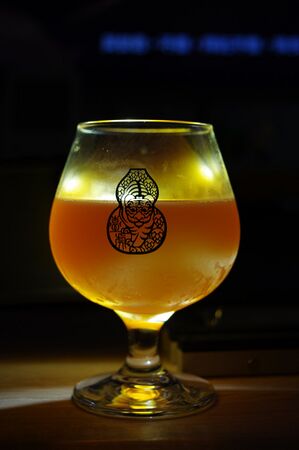 Orange Glow v2.3 (#0007), five weeks after brew day
-
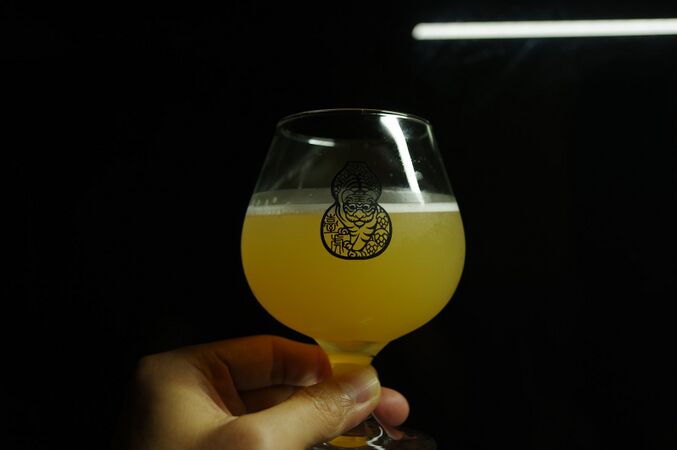 A finished hazy IPA, in the glass with the piz brewing logo
-
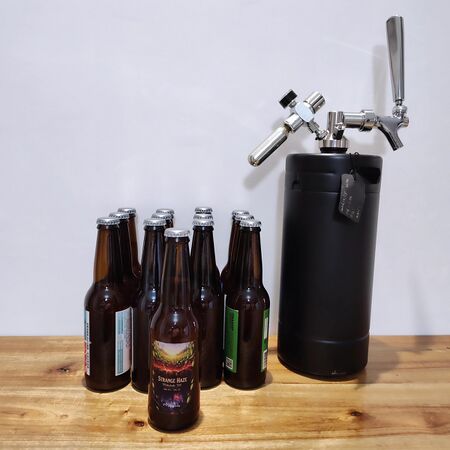 Keg and bottles, with the Strange Haze label in front


| Batches | Period | Batch size | Styles | Recipes (current version) |
|---|---|---|---|---|
| 11 (12 brews) | 2025-12 → 2026-10 | 6–11.5 L | Hazy IPA, DDH NEIPA, Milkshake IPA | 妃子起笑 Crazy Concubine (v4.4), Orange Glow (v2.6), Strange Haze (v1.1), Milkshake IPA (v1) |
The data

The first six batches had no written recipe and wild original gravities (up to 1.110 — a 10.5% "IPA"). From #0007 on, every batch follows a versioned recipe and the OG has been pulled back into the 1.050–1.076 range the recipes are designed for.

Attenuation went from ~71% (early batches, under-pitched, no oxygen) to a consistent 81–88% once pure-oxygen pitching, yeast nutrient and modern yeast strains were adopted. #0011's 62% is not a stuck fermentation: it is a kit recipe with 50 g of unfermentable lactose, and it landed exactly on the kit's printed OG 1.052 / FG 1.020.

The single most useful chart. With one pack of Verdant and no oxygen (#0006) fermentation drags on for 12 days. With LalBrew Pomona, or two packs plus pure oxygen, ~90% of the sugar is gone within 2 days. Any schedule written as "dry hop on Day 3" is simply wrong for these yeasts.

Since #0009 each batch starts with a one-line written plan (dry-hop day and gravity, green-light day, transfer day, expected FG). The log then measures the error. The first two plans were badly off — fermentation finished 8–12 days early — and each new plan is corrected from the previous error. #0011's DH1, DH2 and FG all landed within a day of plan (1.0, 0.8 and 0.8 days early).

pH turned out to be the hidden cause of "too bitter" — and, in #0011, of "slightly sour". The same tap water gave a mash pH of 4.76 in one batch and 5.81 in another, so the correction has to go in either direction. #0011's mash was corrected to 5.37, but the wort measured 4.83 after the boil and was not corrected again; the beer finished at 3.94. In both #0008 (4.75 → 3.83) and #0011 (4.83 → 3.94) pH fell about 0.9 during fermentation, not the textbook 0.3–0.5 — this soft, low-alkalinity water has almost no buffer.
Fermentation with the RAPT Pill (#0012)
- 0012 (Orange Glow v2.6, brewed 2026-11-10, LalBrew Pomona, OG 1.068) is the first batch logged by the RAPT Pill: a gravity and temperature reading every 15 minutes instead of a hydrometer sample every 12 h. The three charts below come from that batch and show how the fermentation was steered from the data.

The plan is written in gravity, not days: DH1 goes in when gravity is half-way from OG to FG (1.039–1.029 for OG 1.068), and the diacetyl rest starts at ≤ 1.020. Krausen took ~13 h to appear (the wort was pitched at 22.8 °C and then cooled to 17–18 °C), but once going this yeast was faster than #0009 at the same stage. DH1 (56 g Nectaron + Citra, bagged) went in at 1.041 on Day 1.2 — deliberately ~2 points early, because dry-hopping early costs nothing in biotransformation and dry-hopping late is how #0010 missed its window. The bath went up to 21.5 °C for the diacetyl rest at 1.022 on Day 1.5, without waiting for the last 2 points.

- The Pill reads high by a fixed offset. Two degassed hydrometer checks (at pitch and on Day 1) both put it ~13.5 points above the true gravity, so it is a constant offset, not a scaling error. The dashed line is Pill − 13.5. Recalibration is deliberately left until transfer: recalibrating in the middle of fermentation would put a step in the curve, and nobody reading it later could tell that step from fermentation. Alarm thresholds are converted to Pill units instead (DH1 window 1.039–1.029 → Pill 1.053–1.043).
- Ignore the Pill while krausen sits on it. Around hour 13 the raw reading rose from 1.0814 to 1.0869. Gravity cannot go up, and warming would make a tilt hydrometer read lower, not higher, so the cause is CO₂ bubbles and krausen pushing the Pill more upright. The bump marks the start of fermentation; it is not data.
- Degas every hydrometer sample. The Day 1 sample read 1.056 straight from the tap and 1.051 after degassing and temperature correction. What matters is bubbles stuck on the hydrometer, not whether the sample looks fizzy.
- Take beer temperature from the Pill, not from the sample. A sample warms up in the room within minutes. After the bath was set to 21.5 °C the beer climbed only ~0.3 °C/h, so the 3-day diacetyl rest is counted from when the beer reaches 21.5 °C, not from when the setpoint was changed.

The rate is the change in Pill gravity smoothed over a ±1.5 h centred window (differences between neighbouring 15-minute readings are almost pure noise), in points per day — the same unit as RAPT's Gravity Velocity alert. It rose from ~31 points/day at hour 18 to ~73 around the start of the diacetyl rest, and has been falling since. When the line stays under 2 points/day, the gravity has stopped changing. That is one of the two green-light conditions; the other is 3 days at 20–22 °C.
As of 2026-11-12 the raw Pill reading has levelled off at ~1.025, which is ~1.012 true — inside the 1.011–1.014 FG target, for about 7.4% ABV. Next: pull the DH1 bag and take a degassed hydrometer sample on 11/14 (to confirm FG and check whether the offset has drifted), then the green-light check and DH2 (84 g, loose) on 11/15.

Batch log
| # | Date | Beer / version | Yeast | OG → FG | ABV | Result / key lesson |
|---|---|---|---|---|---|---|
| 0001 | 2025-12-03 | DDH Hazy IPA | LalBrew New England | 1.062 → 1.018 | 5.8% | Bottle-conditioned. Lesson: add priming sugar, don't refrigerate during bottle conditioning. |
| 0002 | 2025-12-28 | Hazy IPA | Mauribrew Weiss | 1.040 → ? | – | Poor mash efficiency; dry-hop order wrong; forgot to measure FG before bottling. |
| 0003-1 | 2026-02-26 | IPA | Mauribrew ALE514 | 1.050 → 1.010 | 5.3% | Flat aroma and taste; too much priming sugar, vegetal smell. |
| 0003-2 | 2026-02-28 | IPA + 900 g oats | ALE514 | 1.056 → 1.016 | 5.3% | Under-pitched; bottled while airlock still active → gushers on opening. |
| 0004 | 2026-03-15 | Milkshake IPA | LalBrew New England | 1.110 → 1.030 | 10.5% | Lid not sealed (airlock silent 36 h); bottled while still fermenting; weak carbonation, slightly sour. |
| 0005 | 2026-04-23 | Milkshake IPA "light" | Verdant IPA | 1.102 → 1.030 | ~9.5% | Failed. Bittering hops 22 g instead of 6 g; bottles never carbonated — at ~9.5% ABV the yeast was too stressed to referment, and the cold crash removed what was left. Most poured away. |
| 0006 | 2026-05-09 | Hazy IPA | Verdant IPA | 1.062 → 1.008 | 7.1% | Second dry hop at Day 9 triggered hop creep (1.014 → 1.008). Clean, bitterness fine, aroma weak. First keg + forced carbonation. |
| 0007 | 2026-06-12 | Orange Glow v2.3 | Verdant IPA | 1.080 → 1.015 | 8.5% | First versioned recipe. Not hot, bitterness right after 3 weeks, but aroma lacking and colour unappealing. |
| 0008 | 2026-06-25 | Orange Glow v2.4 | LalBrew Pomona | 1.090 → 1.016 | 9.7% | Pomona hit 1.016 by Day 3 — dry hop missed its window. Finished pH 3.83 → harsh bitterness drowned the juice. |
| 0009 | 2026-07-29 | Orange Glow v2.5 "clean" | Pomona | 1.050 → 1.006 | 5.8% | Boiled off 4–5 L, OG shot to 1.110, over-diluted back to 1.050. pH 4.30 — bitterness finally right. Thin body, under-carbonated (keg fridge is 7–8 °C, not 3 °C). Passable daily hazy. |
| 0010 | 2026-08-26 | Strange Haze v1 (blueberry vanilla) | Verdant ×2 | 1.070 → 1.012 | 7.6% | Pre-boil OG check caught an over-concentrated wort in time. No harshness, no diacetyl — but not enough juice, sweetness, purple colour or vanilla; grainy from 20% oats. |
| 0011 | 2026-10-08 | 妃子起笑 v4.3 (PB Craft kit) | Weiss | 1.052 → 1.020 | 4.2% | Clean process — no diacetyl, oxidation or harsh bitterness, no bottle bombs — but weak aroma, thin "watery" body, pale (3–4 SRM) and slightly sour (pH 3.94). Every flaw traced to three fixable numbers: post-boil pH not corrected, CaCl₂ only 0.5 g, both dry hops added while still fermenting. Led to v4.4 and to recipe-wide changes. |
The beers
- 妃子起笑 · Crazy Concubine — Hazy Pale Ale (OG 1.052, ~5%)
- The first recipe. v1's second dry hop went in after fermentation had finished and hop creep ate the body (FG 1.014 → 1.008, 5.8% instead of 5%). v3 fixed it with zero new cost — one dry hop during active fermentation, cooler mash, pure-oxygen pitch, no cold crash. v4 added a 78 °C whirlpool for front-end juiciness. #0011 brewed the PB Craft kit exactly as printed (v4.3) and hit the kit's numbers, which showed the kit itself is the limit. v4.4: 10 L instead of 11.5 L (OG back to 1.060), CaCl₂ 3 g, a post-boil pH check, and the dry hops swapped — Idaho Gem first, Citra + Amarillo last. #0002, the same kit, had used that "wrong" order by mistake — and had the lychee aroma #0011 lacked.
- Orange Glow — DDH NEIPA (OG ~1.066, ~7%)
- The main development line: v1 → v2.6 across three brews. Swapped glucose for DME, Extra Pale for Golden Promise, Verdant for Pomona, added ALDC and Fermaid-O, moved to a split dry hop. #0009 drifted to a pale 5.8%; v2.6 brings back Munich for the orange-gold colour and uses a Strata / Mosaic / Nelson / Peacharine hop bill.
- Strange Haze — Imperial Milkshake IPA (blueberry vanilla)
- Built around a pre-printed label (9% ABV, purple nebula), so the fruit is blueberry for colour. v1 was "neither here nor there"; v1.1 cuts bitterness, adds lactose back, raises mash to 69–70 °C and splits 800 g of blueberry between mid-fermentation and post-fermentation.
- Milkshake IPA — low residual sugar (6 L)
- Body from oat/wheat protein instead of lots of lactose; unsweetened mango + passion fruit purée. Not yet brewed under this recipe.
Label and logo
The beers go out under the name piz brewing. The logo started from our dog, became a pencil sketch of just the ears and nose, and was finished with AI image generation. The labels were made the same way: many drafts generated and refined until one fit the beer.
-
 The original
-
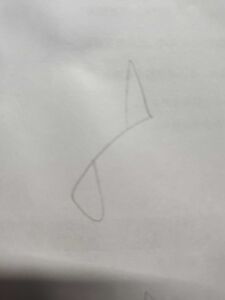 Pencil sketch: ears and nose
-
 Final logo
-
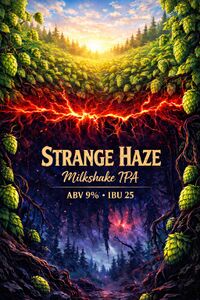 Strange Haze label, made with AI image generation


What I learned
Fermentation
- Dry hop by gravity, not by the calendar. The first dry hop goes in when gravity has dropped about half-way from OG to FG, while yeast is still active (biotransformation + it mops up hop-creep sugar). With fast yeast that can be Day 1, so start measuring every 12 h from Day 1.
- Split dry hop. DH1 during active fermentation for biotransformation; DH2 only after fermentation has stopped, so the CO₂ doesn't scrub the aroma away. After DH2, confirm gravity is stable again (second wave of hop creep). #0011 put both dry hops in while it was still fermenting, and the empty glass smelled only of malt.
- The last dry hop is the aroma you smell. It soaks latest, is scrubbed least and has the least time to oxidise, so put the signature hop (e.g. Citra) there, loose rather than in a bag. Only bag the dry hop you plan to pull out.
- Hop creep is real. Hop enzymes break down dextrins, so a late dry hop restarts fermentation: thinner body, higher ABV, and in bottles — gushers or bombs.
- "Green light" before packaging: two gravity readings ~48 h apart that differ by ≤ 0.001, and at least 3 days of diacetyl rest at a beer temperature of 20–22 °C (water bath 21.5 °C). Since 2026-09 the rest time replaces the forced diacetyl test: below 18 °C the yeast barely cleans up diacetyl, above 24 °C it only adds fusel alcohols, so 3 days at 20–22 °C is the guarantee. After DH2 or fruit, hop creep can make new diacetyl, so hold 20–22 °C for another 48 h and re-check gravity before cold-crashing. #0011 was packaged before creep had stopped and still had no butter flavour. If a beer does taste buttery, warm the keg back to room temperature for 3 days. Never package on a fixed day count — #0003-2, #0004 and #0008 all did, and all had carbonation problems.
- Pure oxygen 60–90 s before pitching lets a single dry pack ferment a 1.07+ wort; no starter needed. After pitching, oxygen is the enemy.
- Fermenting beer runs 1–2 °C above the water bath during the first 48 h. Set the bath ~1.5 °C below the target beer temperature at peak, then raise it to 21.5 °C for the diacetyl rest.
Brew day
- Check pre-boil gravity and volume before boiling. Weigh the pot (total − empty pot weight ≈ litres), measure pre-boil gravity, and compute the target end volume = pre-boil points × litres ÷ target points. Boil to that volume, not to a timer. #0009 boiled off 4–5 L (normal is 1–2 L) and hit 1.110.
- Boil gently, lid off. Hard boiling over-concentrates bitterness and scorches. Excess evaporation turned out to be a big part of the "nasty bitterness" in #0007/#0008.
- Measure mash pH, not water pH, and be ready to go both ways. Sample 10–15 min after mash-in, cool to 20–25 °C, target 5.2–5.4. Keep both baking soda and phosphoric/lactic acid on hand. This soft, low-alkalinity water swings hard: ~1 g baking soda ≈ +0.67, 1 ml phosphoric ≈ −0.28 — use half steps and re-measure. Calibrate the pH pen every brew day and store the electrode wet.
- Post-boil pH is a second, separate checkpoint. A long boil concentrates the acidity too: #0011 boiled 14.55 L down to 11.5 L and dropped from 5.37 to 4.83. Correct the cooled wort to 5.2–5.4 before pitching; with a ~0.9 drop in fermentation that lands the beer at ~4.4. (#0010 split the same 2 g of baking soda between mash and post-boil and had no sourness.)
- Salt: CaCl₂·2H₂O 0.2 g per litre of total brewing water (≈ Ca 54 / Cl 96 ppm), no gypsum. The filtered water has almost no minerals; #0011's 0.5 g gave ~17 ppm chloride and ~9 ppm calcium, and the beer tasted like "sweet water".
- Pale-malt grists (Extra Pale/Pilsner) tend to mash high (~5.7); grists with Munich plus gypsum tend to mash low.
Bitterness and aroma
- Fix bitterness at the source, never by cutting hops. The culprits were pH (finished pH 3.83 = throat-biting), gypsum (sulfate sharpens bitterness), over-boiling, hops left in too long, and drinking too young. Bittering hops go in a bag, on time, and come out after the boil; dry-hop bags come out after 2–3 days.
- Whirlpool and dry hop do different jobs. Whirlpool (75–78 °C) gives juice on the palate; dry hop gives the aroma in the nose. Cutting either one loses something the other can't replace.
- Aging softens bitterness but kills hop aroma at the same time — fix bitterness at the source and drink fresh (2–3 weeks) instead.
- 0.5 kg oats + 1 kg wheat in 4.5 kg of grain is already enough haze; 1 kg of oats (20%) tasted grainy.
- Lactose: go big or skip it. 50 g in 11.5 L (4.3 g/L) is far below the ~20–25 g/L you can taste — it added nothing.
- A kit guarantees beer, not good beer. The PB Craft kit has no whirlpool hops, no specialty malt, and says nothing about salt or pH. Brewed exactly as printed (#0011), it gives a pale, thin, low-aroma beer; those four things have to be added.
Packaging
- Keg + forced carbonation is now the default (#0009 on). Bottle conditioning kept failing: too much sugar (#0003-1), bottling before fermentation finished (#0003-2, #0004), and #0005 at ~9.5% ABV, where the yeast could not referment.
- Cold crash is now standard (since #0011): 2–4 °C for 24–48 h before transfer. #0006–#0011 never really cold-crashed, and all six got the same notes — weak aroma, "don't know what I'm drinking", grainy. Suspended yeast fits that picture; it is still a hypothesis, to be tested by drinking #0011's keg (no yeast) next to its bottles (live yeast). For bottle conditioning after a cold crash: under 7% ABV enough yeast remains; above 8%, add 1–2 g of an alcohol-tolerant yeast (e.g. EC-1118) at bottling.
- Don't package on a falling gravity with sulfite in the keg. #0011 was packaged at 1.020 while still dropping: no metabisulfite for an early package (keep the yeast alive), and halve the priming sugar for bottles (4.5 g/L — it carbonated without gushing).
- Never bottle the gravity samples. #0011's test bottle made from saved samples gushed and measured pH 3.5 — lactic infection from the open sample cup, not the fermenter (the normal bottles were 3.94). Drink samples on the spot; for a control bottle, fill one more from the main beer.
- Low-oxygen transfer: purge the keg with CO₂ three times, fill from the bottom through the liquid post, minimum headspace.
- Antioxidant in the keg: ascorbic acid 0.3 g + potassium metabisulfite 0.25 g per 10 L, always as a pair. Ascorbic acid alone makes H₂O₂, which with trace iron/copper (Fenton reaction) oxidises the beer worse than nothing. The chemicals are ~20% of the protection; the purging is the other 80%.
- Measure the fridge. The keg fridge is actually 7–8 °C, so 2.4–2.5 volumes needs ~15 PSI, not the textbook 11–12 PSI. #0009 and #0010 were both under-carbonated for this reason. A small 3 L keg also absorbs CO₂ slowly — #0011 was only ~70–80% carbonated after 5 days at pressure; lay it down and shake for 2–3 minutes.
-
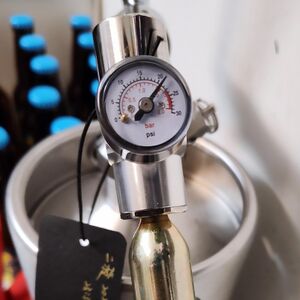 Mini keg with CO₂ regulator: carbonation is set by pressure, not sugar
-
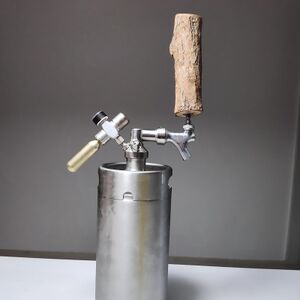 Mini keg with a wooden tap handle
-
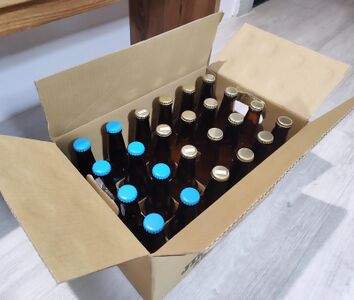 A case of bottles filled from the keg


Method
- Write the plan down before brewing (one line: dry-hop day and gravity, green light, transfer, FG) and measure the error afterwards. The predictions are converging batch by batch.
- Log everything with a timestamp — gravity with date and time, pH with temperature. Most of the lessons above only became visible once the numbers were next to each other.
- Change one or two things per version. The recipe history (Crazy Concubine v1→v4.4, Orange Glow v1→v2.6) reads like a commit log: each version cites the batch that justified it.
Equipment
-
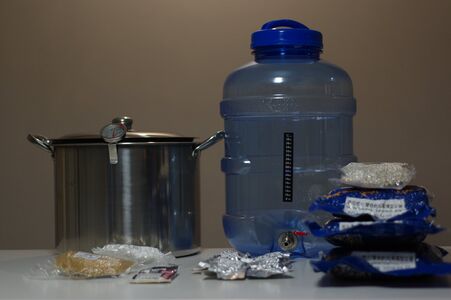 Brew day #0001 (Dec 2025): kettle, fermenter, grain and hops
-
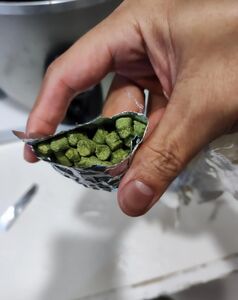 Hop pellets, straight from the vacuum pack
-
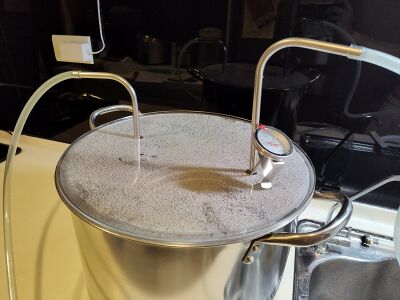 Mashing #0008, thermometer in the lid
-
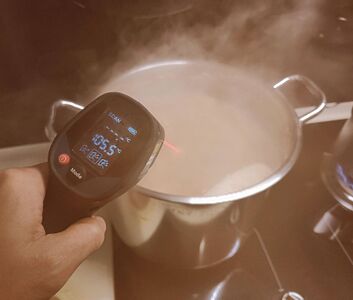 IR thermometer check on the kettle
-
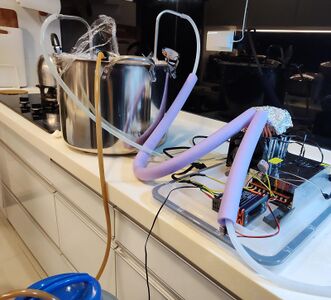 Home-built cooling rig: thermoelectric cooler, power supply and thermostat, pumping cold water through the fermenter
-
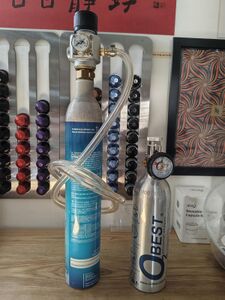 CO₂ (left) and pure O₂ (right) cylinders with regulators
-
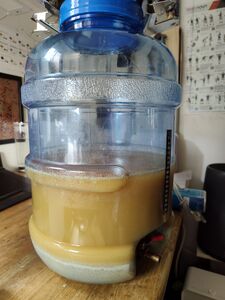 #0008 on Day 3: krausen, fermenting in the water bath
-
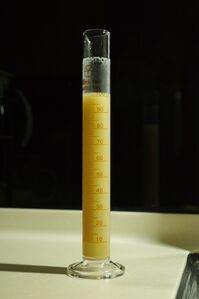 Gravity sample from #0009
-
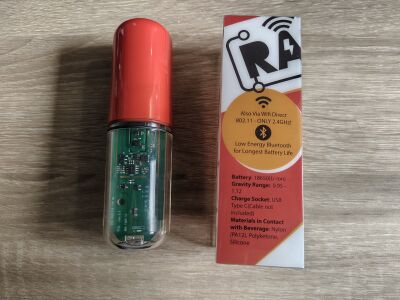 RAPT Pill wireless hydrometer (Nov 2026), next to its box


- Kettle + fermenter in a temperature-controlled water bath; weigh-the-pot volume estimation
- Pure O₂ cylinder with diffusion stone; refractometer + hydrometer; pH pen (4.01 / 7.00 buffers)
- Inkbird IHT-1P instant-read thermometer (from #0010)
- RAPT Pill wireless hydrometer and thermometer (from Nov 2026): floats in the fermenter and logs gravity and temperature over Bluetooth LE or 2.4 GHz Wi-Fi; range 0.95–1.12, rechargeable 18650 battery (USB-C)
- 8 L keg on external CO₂; 128 oz mini keg for in-keg conditioning
- Additives: Fermaid-O (2.5 g at pitch + 2.5 g at ~24 h), Maturex L ALDC 0.2–0.3 ml, CaCl₂